
Every season, introduce a fresh new range of haircuts, textures, and styles. As a result, people embrace and express a different part of their personality with every new emerging trend.
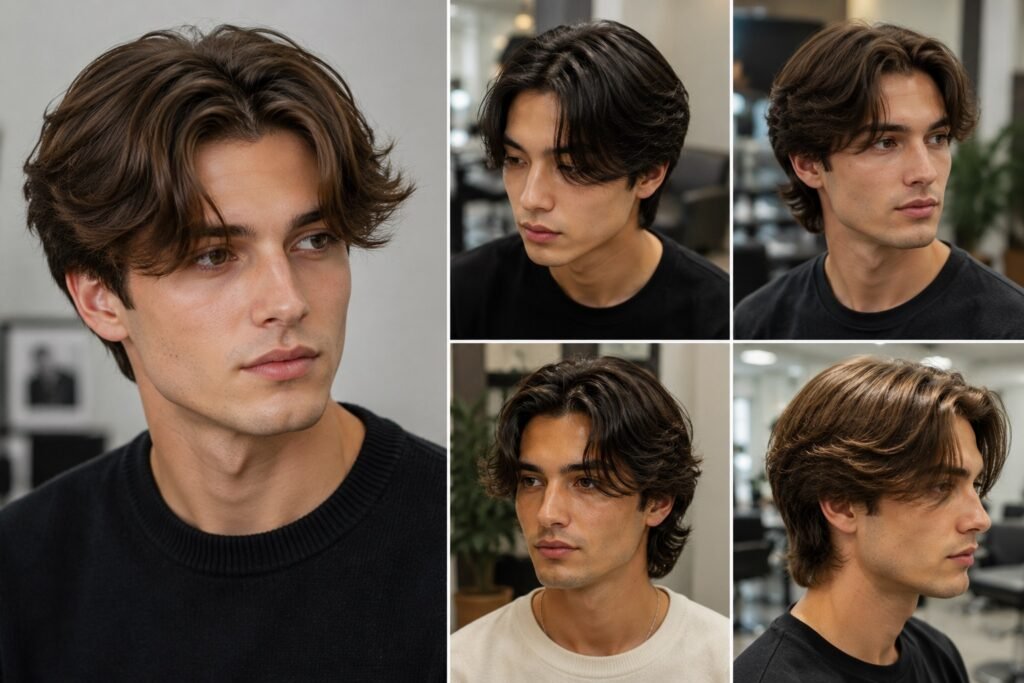
However, a few trims remain timeless, allowing wearers to maintain their signature look. Among them is the Hair Time Salon‘s middle-part curtain hairstyle, which hit the market in the 1990s and has stayed in the spotlight ever since.
This guide specifically explores the unique characteristics of the middle-cut curtain hairstyle and how its technique has changed over the decades.
What is the Center-Parted Curtain Hairstyle?
In the center curtain hairdo technique, the hair is divided symmetrically down the middle. As a result, the sections fall on both sides of the face like a curtain on a window, hence the name “curtain”.
This framing effect naturally softens the facial features while drawing attention to the most striking attributes.
Ancient Tale about the Center Curtain Cut
The middle-part curtain style debuted in the 1990s, and every celebrity, musician, and cultural icon was sporting it, solidifying its status as the hairdo of the decade.
In the preceding years, the trims and looks relied heavily on gels, hairsprays, and appliances. In contrast, the centered-curtain design required minimal styling, making it a much more practical option.
Hence, this choice was a breath of fresh air compared to the heavily styled and voluminous looks.
Moreover, apart from giving a soft, natural appearance, the middle hairline cut complemented a wide variety of face shapes and hair textures. Later on, in the era of spikier cuts, the style did not lose its popularity with a few tweaks in its cutting techniques.
How to Identify the Middle-Part Curtain Hairstyle?
The Center Split
The most recognizable feature of this retro hairdo is the middle parting. The hair has to be evenly divided into two sections and combed to each side. This element sets the stage for the curtain look.
Balance Symmetry
However, for that elegant, effortless, and balanced appearance, there has to be a clean, refined symmetry. Both sections of the parting have to mirror each other perfectly.
Front Framing Layers
Another characteristic is the long front layers flowing gently on either side of the face. Notably, the layers do not cover or fall in front of the face; rather, the hair curves outwards or backwards.
As a result, the facial features become sharper and more defined, especially the cheekbones, eyes, and jawlines.
Soft Textures
At the same time, the multiple soft layers reduce the hair’s bulkiness and heaviness. Above all, even if the hair grows longer, the layers maintain their shape.
Natural Volume
The Hair Time Salon’s middle-parting cutting technique adds volume to the hair, especially around the crown area.
Additionally, the roots are not cut sharply; instead, the technique smooths them out to give a fuller yet subtle appearance. People with fine hair only need to blow-dry their hair, or sometimes do not need to do anything before stepping out of the house.
Adaptable to All Lengths
The biggest strength of the middle-part curtain trim is its ability to suit any hair length. A shorter cut creates a youthful appearance, a medium-length cut is the classic, whereas elegance is intensified on long hair.
How has the Middle-Part Curtain Hairstyle Evolved with Time?
The Classic
The classic middle-part curtain style features medium-length hair with soft layers. It requires the least amount of time to style, making it an ideal choice for the everyday grind.
Textured Concept
The extra layers of this chop give a messier yet relaxed look. Normally, people who have voluminous hair opt for this textured curtain cut.
Wavy and Curly Curtain
The original 1990s curtain cut was typically associated with straight, relaxed hair. However, the current generation is now embracing styled or naturally wavy and curly hair. Hence, the authentic version has been slightly modified to suit such textures without losing its timeless charm.
Long Style
The longer version of the center-parted curtain chop ends just below the cheekbone. Typically, it works best with thicker or wavy hair that naturally has volume. Hence, to bring flow and movement, the layers are blended with the rest.
Short Version
The short center-parted curtain cut is the most modern interpretation and is even easier to maintain and style than the classic chop. Comparatively, the front layers are kept shorter than the rest, either ending near the eyebrows, cheekbones, or sometimes the ears.
Where to Refresh Your Look?
If you are looking to get yourself transformed for any occasion or even treat yourself to a small makeover, Hair Time Salon is the right place for you.
Our team will listen to all your needs and also make them a reality. To ease your mind about our services, visit https://hairtime.us/.